Decontamination
How to decontaminate your car's paint: SIDERO + clay bar, step by step


In short: a full decontamination is done in two steps. First chemical: an iron remover like Labocosmetica SIDERO dissolves iron particles, then MaFra DECA FLASH removes tar. Then mechanical: a clay bar glided over paint lubricated with LUBRIFICA pulls off whatever is left. Do it once or twice a year, and always before polishing or applying protection.
Why decontaminate your paint?
Even after a good wash, contaminants stay stuck in the clear coat: brake dust, iron filings from railways, tar, tree sap and pollution residue. Winter and road construction add a lot more. The result: rough, dull paint, small orange specks on white cars, and a wax or ceramic coating that bonds poorly and beads for less time.
The plastic bag test
After washing, slip your hand into a thin plastic bag and gently run it over the hood, trunk and lower doors. If you feel grit, like very fine sandpaper, the paint needs to be decontaminated.
Chemical or mechanical: what's the difference?
| Chemical decontamination | Mechanical decontamination | |
|---|---|---|
| Products | SIDERO or IRON REMOVER (iron), DECA FLASH (tar) | Clay bar + LUBRIFICA |
| What it removes | Iron particles, tar, adhesive | Anything still sticking out of the surface: residue, embedded dust, overspray |
| Contact | No rubbing | Light gliding contact |
| Order | First | Second |
Always start with the chemical step: it dissolves much of the contamination without contact, so the clay bar has less work to do and is less likely to mark the paint.
What you need
- A pH-neutral shampoo: Labocosmetica SEMPER
- An iron remover: Labocosmetica SIDERO (a gel that clings to vertical surfaces) or Maniac Line IRON REMOVER
- A tar remover: MaFra DECA FLASH
- A MaFra CLAY BAR and Labocosmetica LUBRIFICA lubricant
- Clean microfiber towels, like the Labocosmetica MULTI TOWEL pack, and a DRYING TOWEL
- Nitrile gloves and safety glasses
Everything is grouped in our Decontamination collection.
Step by step
1. Wash the car
Do a full wash (foam prewash, two-bucket method) to remove loose dirt. Work in the shade, on a cool surface. There's no need to dry completely before the next step, but squeeze off most of the water.
2. Apply the iron remover
Spray SIDERO one panel at a time, or on the whole car if it's cool out. After a few moments, the product turns purple where it reacts with iron: that's normal, it's proof that it's working. Let it dwell a few minutes according to the label, never letting it dry, then rinse thoroughly. Do the wheels too, as they usually carry the most brake dust.
3. Remove tar
The small black dots behind the wheels and along the rocker panels are tar. Spray DECA FLASH, let it work for a minute, wipe gently with a microfiber towel, then rinse or rewash the area.
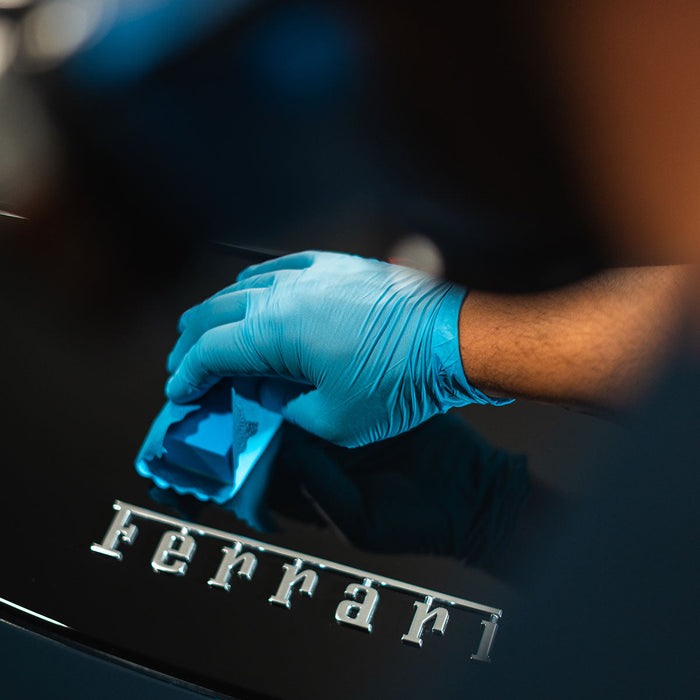
4. Clay the paint
- Take about a quarter of the bar, warm it in your hands and flatten it into a patty.
- Spray LUBRIFICA generously on an area about 50 cm × 50 cm (20 in × 20 in).
- Glide the clay in straight lines without pressing, adding lubricant as soon as it grabs.
- At first, you will feel and hear the bar grab. When it glides with no noise or resistance, the area is clean.
- Wipe with a clean microfiber towel and move to the next area. Fold the clay often to expose a clean side.
Do all the paint, the glass and the headlights. The most contaminated surfaces are usually the hood, front bumper, trunk and lower doors.
5. Rinse, dry and protect
Rinse or quickly rewash to remove lubricant residue, then dry. Your paint is now "bare": it's the perfect time to polish if needed, then apply protection, for example a sealant like CUPIDO, a quick sealant like BENEFICIA or a ceramic coating like HPC 2.0.
Mistakes to avoid
- Working in the sun or on a hot surface: products dry and can leave marks.
- Letting the iron remover dry: always rinse before it dries.
- Not using enough lubricant: a clay bar rubbing dry can mar the clear coat.
- Reusing a clay bar that fell on the ground: it has picked up sand. Throw that piece away.
- Forgetting protection: after decontamination, the paint has no protective layer left.
How often?
For a daily driver in a cold climate, a full decontamination in spring (to remove winter residue) and in fall (before applying winter protection) is ideal. In between, a pass of SIDERO on the wheels and rocker panels is often enough.
More questions? Check out our car detailing FAQ or write to us: we'll help you choose the right products.
Frequently asked questions
How often should you decontaminate your car?
For a daily driver in a harsh winter climate, a full decontamination twice a year is ideal: in spring, to remove winter residue, and in fall, before applying winter protection. In between, a pass of SIDERO on the wheels and lower panels is often enough.
Why does SIDERO turn purple on the car?
That's normal: the product changes color where it reacts with embedded iron particles (brake dust, rail dust). The more purple you see, the more contaminated the paint was. Let it dwell a few minutes without letting it dry, then rinse thoroughly.
Can a clay bar scratch the paint?
Is SIDERO safe on a ceramic coating?
Iron removers are commonly used on protected cars, since they work on the iron without scrubbing. Always check your coating manufacturer's recommendations.
Can you skip the clay bar step?
For maintenance between two protections, yes: chemical decontamination alone already makes a big difference. Before polishing or a ceramic coating, the clay bar is strongly recommended, because the product needs to bond to a perfectly smooth clear coat.
The gear
Products in this guide
Keep reading